

Quick answer:
A film pitch deck is a visual treatment of how you’re going to tell your story. It shows the overall mood of the film, its world, the main players, the cinematic style, and financial industry comps — a top-level, graphic picture of your project that someone can understand at a glance, far faster than reading your script. I call them picture books for executives, and I mean that as a compliment to both of you.
Why pitch decks matter more now than ever
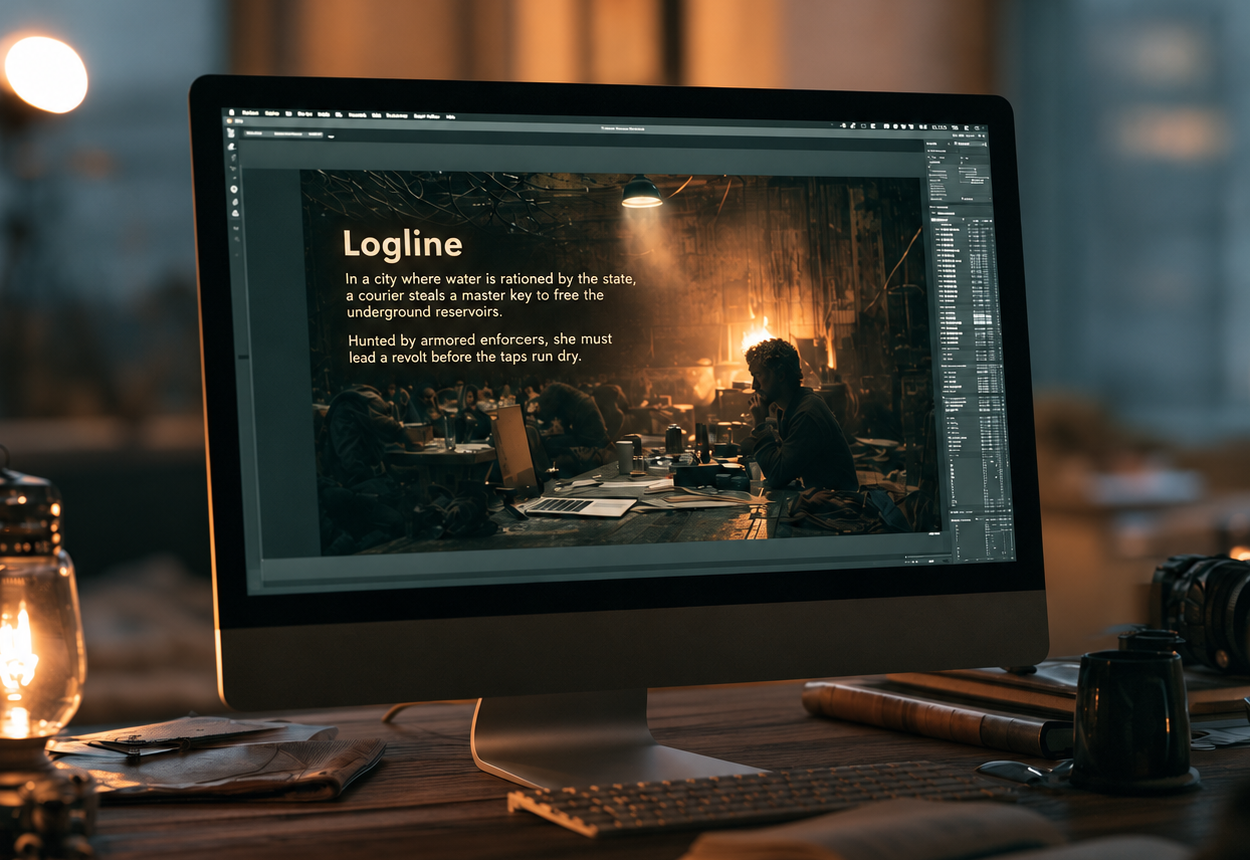
We used to, back in the '90s and 2000s, be able to write a great script and get funded. Now, that’s not the case. Investors have realized that a great script doesn’t mean a great film. Scripts are the foundation. Great films come from the execution.
A pitch deck is a conversation starter. It’s your first opportunity to turn your script and your story into a cinematic experience — to show them how you’re bringing your vision to life before you shoot a single frame. They are the first experience of your film. They show how you plan to execute your film and why it is a good investment financially and creatively.
Who your deck is really for: Four functions
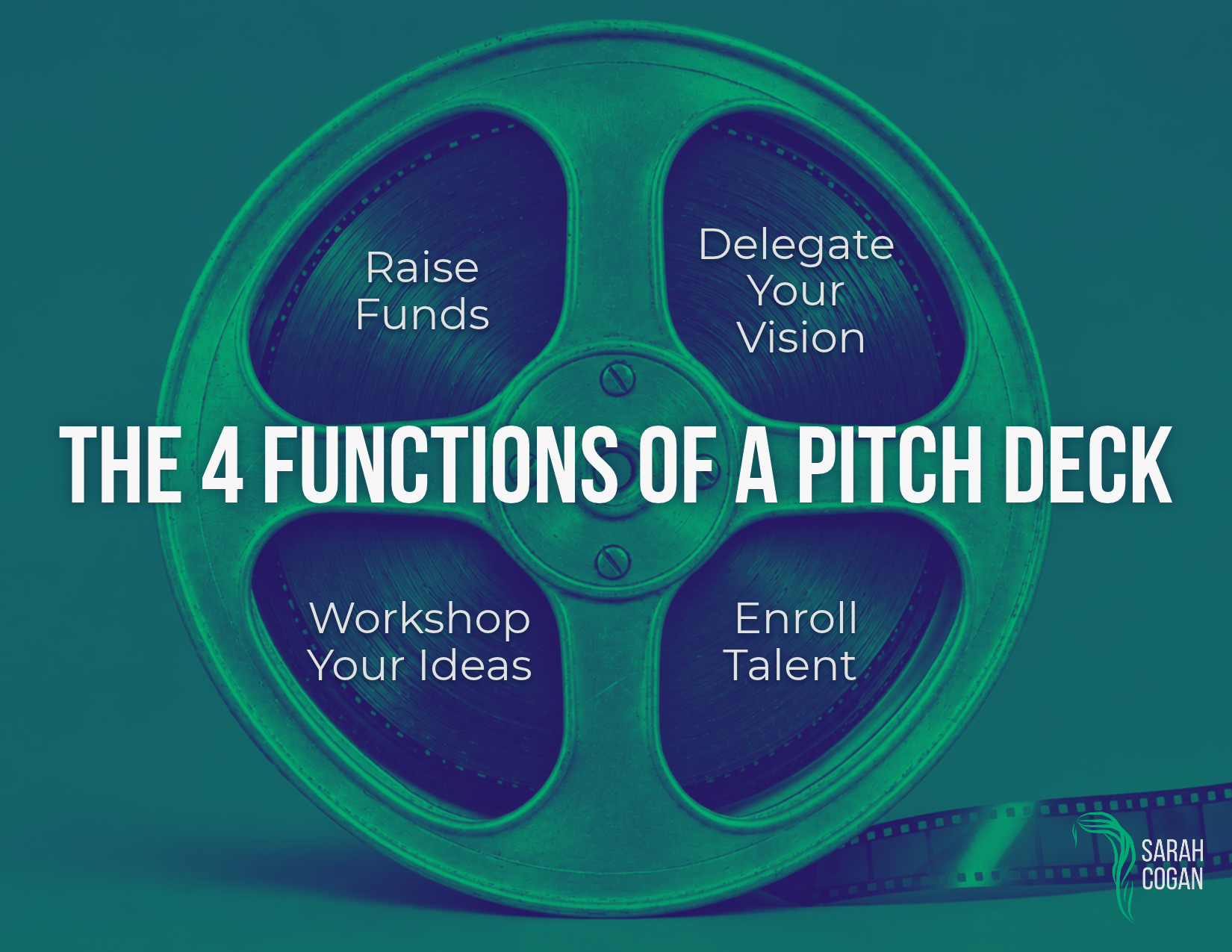
There are four functions a pitch deck serves. Knowing which one you’re doing right now changes what belongs on the pages.
1. Your Pitch deck raises funds
A well-crafted pitch deck says: you can trust me with your money, and I won’t get you fired or bankrupt you because I don’t know what I’m doing.
Investing is about making money with your money. It’s a business transaction. Whereas donating to a film is about supporting art.
Investors want their money back and then some. They want to know why they should risk their hard-earned money on you. A strong deck gives investors confidence that you know how to craft a well-made film, since your pitch deck already creates a cinematic experience for them.
2. They enroll talent
Your deck tells talent — whether it’s cast or department heads — that you have a clear vision for your film. Pitch decks allow creatives to understand your vision and see if it’s something that resonates on a deeper level than just talking can. A pitch deck can help you bring on stronger talent because your creative vision is well articulated, giving the creatives the sense that they will thrive on your project.
3. They workshop your creative vision
By nature, pitch decks require you to ask the visual questions for your film. How are we experiencing the world of the film through the camera lens, the color, the lighting, the textures, etc. Thinking through these concepts even before we get funded lets you play with ideas and see what works best for your film.
Research can be the most eye-opening part of the pitch deck process and, when done right, allows a creative vision to emerge from the research rather than what we think it should be.
Let’s say you want a red door in your pitch deck. You could look for one red door and use that. Or, you can pull dozens of images of red doors to see the subconscious and unexpected patterns that show up for you. Are the doors you’re gravitating towards large or small? Windows or no windows? Smooth or rough?
When we look at the patterns in our research and wait to make any hard decisions, we give ourselves the chance for your creative vision to breathe and thrive. This gives every page of our decks a clearer creative vision.
4. They help delegate your creative vision
As a filmmaker, you are delegating your creative vision across multiple departments. A well-crafted pitch deck can articulate your creative vision in a way that lets your department heads hit the ground running from day one. This saves department heads precious prep days going the wrong direction because what you call pastels are actually muted tones, or any other miscommunication that an image would clarify.
When you expand your pitch deck into a lookbook, you can go deeper into your creative vision, giving your collaborators more information to help them serve it.
Different Decks for Different purposes
But the deck you send to a financier and the deck you hand a designer aren’t necessarily the same document — which is why you build variations of your deck. A version focused on the financial viability of your project, then the story for investors. A version for talent and creatives that starts with the story and creative vision, leaving the financials out.
Your deck is a calling card

The title or cover page of your pitch deck is the first impression people get of your film and you. Your name should be on it. People need to know who you are from the start—not on the last page with your film bio.
You also want people to remember the name of your project. Put the project name next to the page number on every page.
Marketers understand the importance of repetition. Marketers now estimate that it takes a minimum of five to seven touchpoints before someone remembers something enough to move a relationship forward. Every place your name or your film’s name appears is a touchpoint.
This is important because…
You never know where a pitch might take you. You might be vying for something you don’t even know you’re vying for.
Someone could see your deck, pass on the project, and go, “You know what? We don’t want that film, but we’re doing this other project, and she seemed really interesting. Let’s call her in.”
Pitch deck or lookbook?
There’s a ton of confusion in the film industry around this, and most filmmakers think they’re the same thing. They’re not. The relationship between them is like an iceberg's body to its tip sticking out of the water — here’s the full breakdown.
Put it into practice
Make a list of the people you are sending your pitch deck to (investors, creatives, donors, etc.)
For each person or category on the list, ask what is most important to them. Not just investors making money, but why the investors you're talking to will love your film and make money. Creatives? Maybe it’s the creative fulfillment your project will give them. If you have a specific person in mind, what’s in it for them?
What story are you telling them in your pitch deck, and how does that change the organization of information? What information does one group want that another wouldn’t want? Which pages can overlap across decks, and which need to be customized to the specific needs of that group?
Create a project folder — this is where your research, drafts, and notes will live.
Organize subfolders to keep your visual research separate from your notes and copy drafts.
Create subfolders for your research images. Which ones inspire your cinematography? Which are for characters, locations, makeup, etc.? Suppose there’s an image that overlaps in both categories, great. Put the image in both folders.
When you’ve exhausted yourself with your research, go back through your folders and look at the patterns. Which images still work for you? Which images no longer speak to you? Put the images that no longer speak to you in a backup folder. Keep them just in case.
Create your pitch deck outline to know how many pages your deck needs, how many images you want and need to provide
Tip: make every page add to your vision by using images. Every page wants to be cinematic.
FAQ
What is a film pitch deck?
A visual treatment of how you’re going to tell your story — the overall mood for the film, its world, the main players, and the cinematic style. It gives a broader picture of what’s going on at a high level and from a graphic standpoint, allowing people to understand your story at a glance, much more quickly than reading your script.
What is the difference between a pitch deck and a lookbook?
A pitch deck is the tip of the iceberg — a quick overview designed to get people interested in learning more. A lookbook is the mass below the waterline: the director’s or showrunner’s full creative vision across every area of the film. Full comparison here.
Do I need a pitch deck if I have a finished script?
Film scripts are strategically focused on dialogue and action, which means there’s almost no description of the tangible world — those choices are deferred to the filmmakers. If you’re selling your script or pitching it to a director, you can get away with a one-page treatment. If you’re looking to direct the film or raise production funds, then mostly yes. There are always exceptions.
Who reads a film pitch deck?
Investors, executives, donors, and your own collaborators — cast, line producers, designers, cinematographers.
Should I put my production company logo or my own name on the cover?
Yes. Your name or company should always be on your cover page — “a film by [you],” or “a film by [you] in association with [production company]” or “A [production company] film,” a format like any of these that puts your name front and center. People want to know who’s behind your project before they buy into your project.
Want to take your pitch deck to the next level? Check out The Art of the Pitch Deck.